
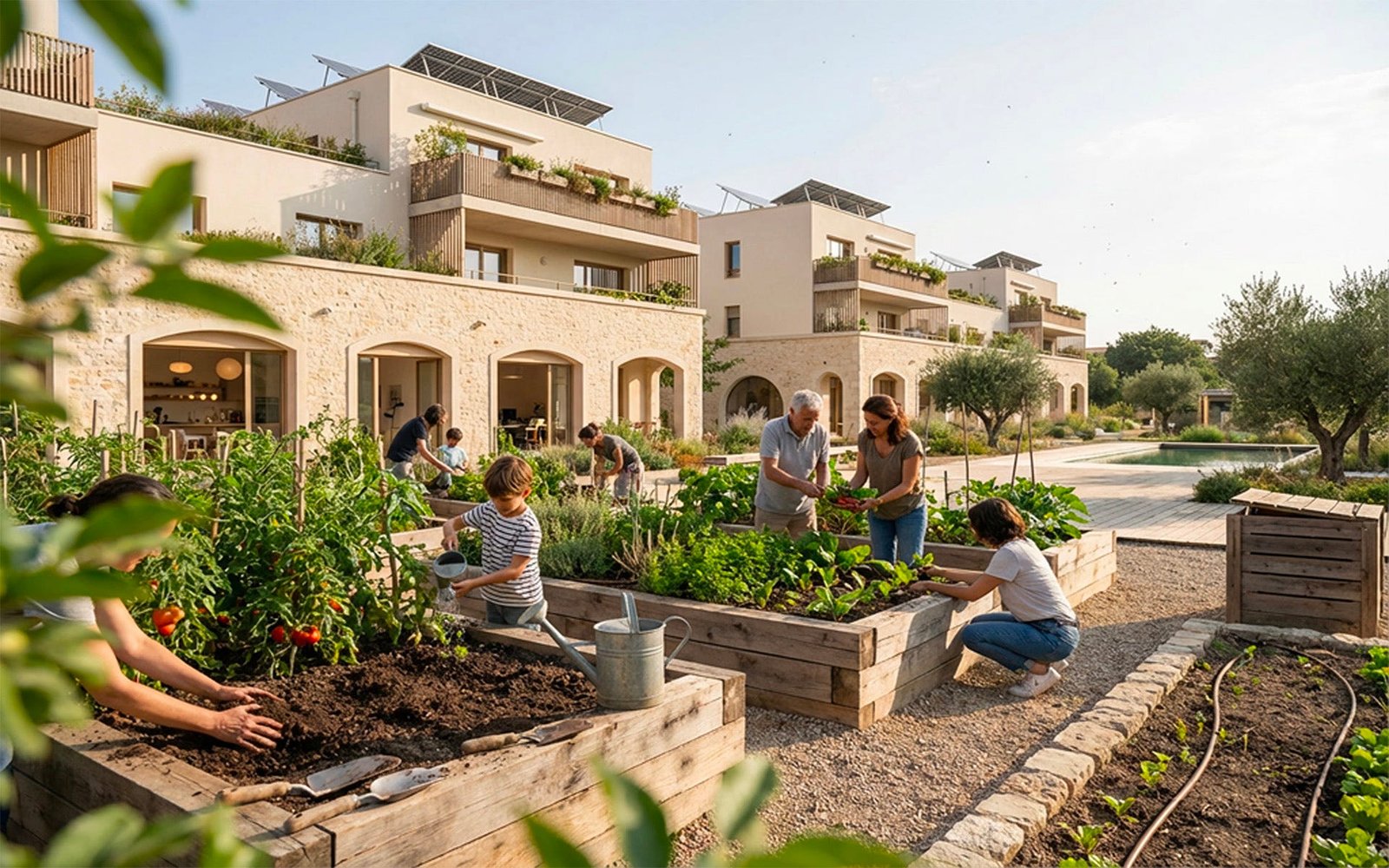
If our homes isolate us, let’s design them differently.
Our need for community is too important to be left to chance.
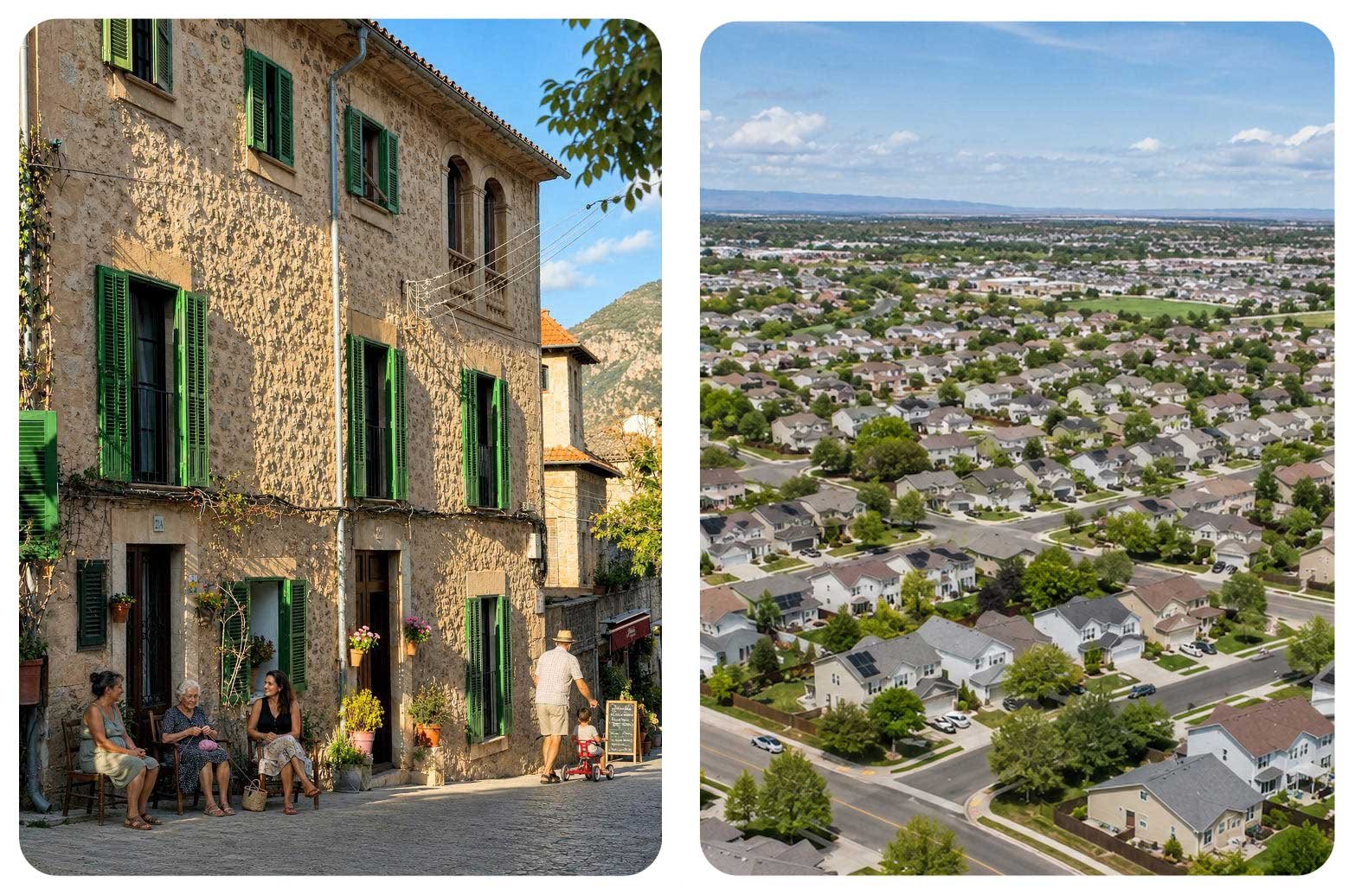
A few years ago I was driving through one of Mallorca’s smaller villages. I slowed down because I was surprised to stumble upon a scene. A grandfather in the middle of the street, pushing his grandchild on a tricycle. Other kids playing a few meters over. A little further on, three women had brought chairs out to the sidewalk and were knitting and talking, pausing to say hello to neighbors walking by.
Even though this was a street made for cars, it was the cars themselves that felt out of place. But on a slow Sunday afternoon, the neighbors had simply brought some chairs outside and created their own communal space. The daily life I was observing in these traditional narrow streets was what truly belonged.
Community vs. “community”
Now hold that picture next to a typical American suburb or city apartment building. We might have lived there for years, but many of us still don’t know most of our neighbors. That isolation isn’t a personal failure. It’s the predictable result of how we’ve been building homes for the last century. Car-centric suburbs and densely populated buildings in cities that simply don’t provide easy and natural places for people to connect in.
This is the first in a four-part series on the foundations of Alluma, a new way of reimagining the way we live and a housing format we’re calling “regenerative communities”. I’m starting here, with the first one: Community and Connection, because the other three foundations -Health & Wellbeing, Regenerative Building, and Systems & Technology for Good- only work if this first one is solved.
Because a home that gives back more than it takes, but leaves you alone inside it, has missed the point of being a home.
A false choice and the ache underneath it.
We’ve been sold a binary. Either we show the world how independent and successful we’ve become by striving for the best single-family house or fully equipped apartment we can buy or rent. Or, for the few brave enough to try something different, we can go all in with options, like co-housing, eco-villages or a kibbutz, that prioritize belonging to a community. But whether we realize or not, both of these choices require significant sacrifice.
One gives us independence without belonging. The other gives us belonging and shared values without enough space for individuality. But we need both, and this lack of balance leaves us wanting, especially when the only options available in the market force us to choose one or the other.
At first I thought it might just be me who wanted something different. But when I asked around -friends, family, colleagues, mentors-, I learned that in fact everyone wants that balance. Parents want kids to grow up with close ties to family, friends, and neighbors and develop deep roots to their place. Kids want opportunities to discover, play, and be in nature, with others. As we age, we want to live somewhere we can feel useful, and to age in place safely and meaningfully among others, for as long as possible. As working adults we want to live in a place where we can find friendships to share joys and responsibilities with. All of us want to live in homes that are good for our health, and most of us want to do things that are also goof for our communities, and the planet. And everyone wants to feel seen and valued.
So why do most of us get caught in the trap of choosing independence-focused homes, when we know we want and need something different?
There are two main reasons:
- because the economy prioritizes profitability over wellbeing (which limits what gets built and offered in the market), and
- because our society today prioritizes individuality over community.
We’ve previously addressed the first issue. In this essay we address the second.
There’s a reason many community focused formats are seen as fringe options. They require us to give up too much of our individuality, a human need that is central to our wellbeing. On the other end of the spectrum, as we’re seeing in our societies today, too much individualism gives us polarization, a homogenous circle that makes us feel safe in a complex world, and the quiet belief that our neighbors, the larger communities we live in, and the planet aren’t really our problem.
Neither extreme works over time. And just like nature finds the right balance between evolution and stasis, we need to find the right balance in designing spaces for both individuality and community.
So now, with the pendulum having swung far into the realm of individualism, the real question is: What would we have to change about how we design our homes in order for community and connection to find its way back into our lives naturally, instead of something we have to arrange for?
Design impacts behavior. And behavior impacts our lives. The question then: How do we design for balance between independence and community and connection?
Four design choices
A lot of people ask whether the concept of Alluma is similar to other housing formats. “Is it like co-housing or an intentional community, an eco-village or a modern gated community?” These comparisons try to offer greater understanding and clarity, but the reality is much more complex.
Alluma has actually taken inspiration from many different formats, whether because of their focus on community, sustainability, wellness, accessibility, and more. These formats have bravely tested how best to address a particular issue or need. They have taken great risks and offer tremendous inspiration, and Alluma wouldn’t be here without their valuable insights into how housing can offer paths to living better, healthier, and more meaningful lives.
Our homes have long been built around independence as an ideal. But now that we can see what that independence costs us, it’s easier to think about what we might do instead.
The strategies ahead fall into four distinct design choices — each one a step toward building community in a way that feels natural rather than forced; toward the right balance between both individuality and community; and which may look back in time for inspiration when applicable, but always with a forward, long-term mindset in the ways in which they’re applied.
The first is what we’re calling a realignment of space.
When our homes are designed for independence, they dedicate an important share of their square footage to spaces, materials, and systems that are used inefficiently or which keep us indoors and isolated. A kitchen with enough storage for seldom-used equipment. A formal dining room that is used only a handful of times a year. A laundry room that has machines equipped to run 16+ loads a day, but which only get used a few times a week. A guest room, playroom or private pool that’s enjoyed by one family and sits unused too much of the year.
Add to that, our now almost infinite online ordering options (food, clothes, home goods, essentials, entertainment, and more) which makes getting everything we desire easier and faster than going outside. Plus, our ability to work, workout, and communicate without ever having to leave our homes. It’s not surprising then, that the number of times we go outside and connect to people and nature has plummeted.
And this has consequences. On our wellbeing, on our society, our economy, and our planet. Because our need to connect with other human beings and with nature has not changed. We’ve just eliminated all the reasons and places we did that in. We barely know the people who form part of the fabric of our communities, and we’ve all become more invisible and disconnected from the direct world around us. And when we disconnect, it becomes harder to care.
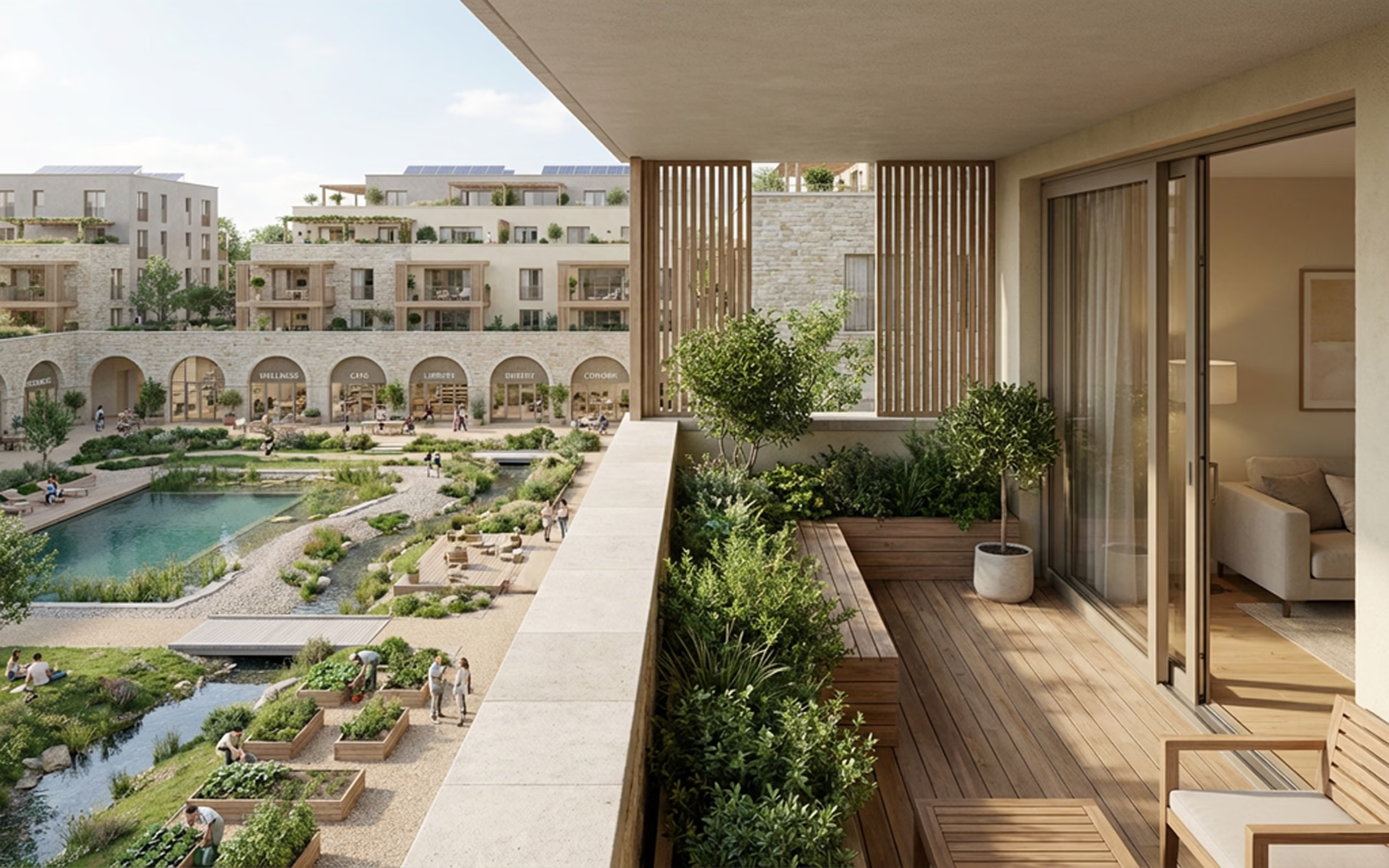
Our vision at Alluma is to realign our spaces and redesign our homes so that they still meet all our basic needs of safety, comfort, and privacy while adding a wide range of wellbeing-inspired shared spaces that give us easy and natural opportunities to connect to each other and to nature. Our homes become our sanctuaries; private, healthy, beautiful, built regeneratively with long-lasting natural materials, good light, air, and sound design, biophilia, thermal comfort and more. Homes that nurture us as individuals and truly feel like home. We eliminate all the inefficiencies and instead use the extra square feet, materials, and systems to provide incredible shared amenities:
-
A communal kitchen and dining room with long communal tables so we can choose when to eat and spend the extra time relaxing and sharing with family and friends (no cooking or clean up required), when to take the prepared food home (because sometimes we need our alone time), and when to cook at home (because we find pleasure in it).
-
A wellness center, gym, and a natural pool that filters itself without chemicals, that most single households would likely never have right outside our front door. And that we actually use because it’s close by and enticing, and seeing others we know motivates us to stay active, social and healthy.
-
Regenerative and organic vegetable, fruit, and flower gardens, bee hives, and maybe even chickens. Strategies that improve the biodiversity of the area and provide us with healthy and beautiful food and environments in a circular system. And which together with biophilic design throughout, connect us to nature.
-
A library, a co-working center, a laundry café, and play and entertainment spaces for both kids and adults, for learning, exploration and creativity.
-
A shared fleet of electric cars, bikes, and scooters we don’t have to own to use.
-
And so much more.
Amenities that keep us and our planet healthy. Chosen by the people who will actually use and benefit from them. When we have a say in how our lives are lived, we invest our time, our care, and our hearts into ensuring we continually become the best that we can be. And it is in having those shared spaces, where we can naturally connect with small, regular interactions, over time, that enables the magic of true community to happen.
Fewer square meters never felt so big!
When we realign our spaces, instead of feeling the loss of space, our lives actually expand into other people and into the spaces and land we share. Our physical and emotional worlds extend and ripple outward, easily and naturally. Yes, we might give up the slight convenience of our personal laundry machine, but if instead we gain a tribe of laundry warriors to laugh and share time with, don’t we gain so much more than we lose? It’s all a matter of perspective.
In realigning our spaces and redesigning our homes, we provide the opportunities for each of us to find the right balance between the private spaces for our inner, more intimate worlds, and our shared spaces for community and connection to others and to nature.
The second is designing for a multigenerational, diverse community from day one.
Buildings tend to be optimized by size, income, ownership structure, or format. These decisions then tend to attract a specific profile. Take size for example. Studios and one-bedroom rental buildings typically attract young professionals who aren’t ready to buy. One- and two-bedrooms condos often attract young couples or small families who might need flexibility to sell easily as their families grow. Co-op apartment buildings with larger layouts often attract larger families who plan to stay long-term, and so on.
We might think that being surrounded by others with a similar profile or in a similar phase of life would be ideal, but long-term this is not generally the case. As time passes our needs change. We get married, have kids who eventually move out. Some get divorced, sick or injured. At each of those junctures, our housing and financial needs change. And if our building or neighborhood isn’t designed to provide the right options for all phases of life, we’re forced to move and live elsewhere. We either lose the connection we had to the people and community we were a part of, or we never make the effort to create connections in the first place knowing we will be moving eventually.
But if moving is one of the more disruptive and stressful events we go through in life, how can we design our homes differently, so we don’t have to?
The answer: instead of building for a specific profile, we build to accommodate a diverse range of needs, for the full cycle of life. That way, the same residents and families can live there in their twenties, their forties, seventies, and more, if they choose to. Different ages. Different needs. Different skills and assets. Different reasons for being there. And we don’t just mean having a diversity of apartment sizes or ownership structures, it’s designing homes having thought through the needs of people of different ages, abilities, dietary needs, cultures, work styles, wisdom, capital, availability, and how these might change over time. When we design for diversity, we broaden the spectrum of people who feel welcome, seen, and cared for, long-term, instead of everyone having to adapt to what the market supplies, and move when we no longer fit in.
A diverse, multigenerational community also has the added advantage of being able to care for each other in personal and meaningful ways, that when we design for limited profiles becomes almost impossible. The retired teacher who can offer to help kids with homework while their parents are still at work and can feel useful while making some extra income. The young professional who can chat with their elderly neighbor to offer companionship while decompressing after a long week, or do some errands for someone ill or elderly and feel good about helping out. The teenagers who can slowly and safely take on new responsibilities as they dog sit, baby sit, or help the younger kids put on a talent show. Or the passionate home cook who can teach others some useful cooking skills that then turns into a flourishing side business.
With the diverse skills, strengths, passions, and assets we have at different stages of life, there is so much potential for helping each other out in ways that are mutually beneficial. It is this diversity that offers optionality, inspires thoughtfulness, and encourages us to care more for each other and for the community we’re a part of. Our diversity opens our eyes to our differences in positive ways, and creates meaningful opportunities for connection that improves our wellbeing.
It is also this diversity that forces us to design better buildings. By seeing the world through the lenses of a broader range of people’s needs, and over a much longer time frame, we are forced to ask and answer more nuanced, complex, and longer-term questions, like:
-
Who will be living here 20, 40, 60 years from now?
-
Will this material or solution last 5, 50, or 100+ years?
-
Can a communal laundry room be more than just functional, or can we design it for the needs of the whole community? For both someone who is injured by offering a paid laundry service as well as the single mother or father who needs a clean and safe space so their child can play while they iron, and everyone else?
-
Does the ownership structure we offer hinder or improve our sense of belonging, care and commitment, through all stages of life? Can we offer flexibility?
-
And like those questions, so we ask of every design decision; viewed from all the angles and perspectives.

A communal laundry room that can be so much more than a chore.
While we don’t expect everyone will live in the same community forever, when we design for a specific profile (the young professional, the retiree, etc.), or a specific need (rental, condo or coop, or specific income level), we’re effectively limiting who the homes are designed for. This narrow focus makes those homes fragile over time to changes in people’s needs. Removing diversity and optionality almost guarantees that residents, knowing they will eventually need to leave, will care less about the building and their neighbors, long-term.
Answering the needs of a diverse, multigenerational group, may require more thought and take longer, but it also opens us to discover creative solutions that end up being better for all long-term (like designing a communal dining room with long tables, so we don’t have to feel alone when our kids leave home, or accessible pathways that work for wheelchairs, strollers, and laundry carts, as well as unexpected games the kids will no doubt invent), creating communities that support us through all of life’s natural cycles.
A diverse, multigenerational community allows us to design for people with different skills, perspectives, strengths, and assets in a way that makes the whole better than the sum of its parts. It builds a community that, by shifting our thinking from the narrower “I” to the broader “we” perspective, and from the short- to the long-term, opens us to see the world differently and results in better solutions for all. This is a fundamental change in perspective that we can build on. Pun intended.
The third is a Community Jobs Marketplace.
One of the aspects that makes Alluma unique is the concept of a Community Jobs Marketplace. A tool that enables a diverse community with extraordinary shared amenities, to also be more flexible, affordable and accessible.
In most cases today, buildings with amenities are geared to higher income residents who can afford to pay significant monthly fees, for both the extra footprint required and for the extra employees needed to maintain and operate them. While our first design point -design realignment- goes a long way to making our amenities more affordable, it may not always be enough to offset the full additional cost. And without some creativity, these additional monthly fees would have made Alluma too expensive for many. Our solution: to give residents the agency and flexibility to participate in the life and operations of the community in all the ways in which a diverse, multigenerational group can. What if the jobs of caring for, maintaining and operating, the community could be performed by the people living in the community? Where residents get paid for the hours they dedicate doing things they enjoy; cheaper and with more care than a management company would; and any jobs not filled by the residents could still be filled by external employees.
That is, each resident, whether through their time, skill, or capital, choses how to contribute to the care and operation of their community. Those who can and wish to dedicate their time and skill can do so, and thereby reduce the amount they would otherwise pay towards the community’s fees. And those who prefer to contribute their capital, simply pay the regular monthly fee.
While co-housing and intentional communities do more than most to build a sense of community, they can fall into the trap of offering only limited or prescriptive options, like a weekly or monthly communal meal that each family takes turns at preparing, or a shared vegetable garden that residents take turns weeding. But what if we’re not all interested in cooking or gardening? Does that mean we don’t fit in or belong?
The Community Jobs Marketplace offers flexibility, agency, and creates opportunities to make our lives more affordable while still providing extraordinary shared amenities that help connect us to each other and to nature. And when we participate meaningfully in the care of our community, we feel seen and valued, and this is what deepens our roots and bonds long-term.
Having many different shared spaces and amenities, creates the opportunity to let each resident decide how to show up for the community in the ways that feel right for each person.
-
Have a passion for sustainability and time to dedicate? Take charge of the gardens and the composting program.
-
Love animals and want to learn to help care for the bee hives or chickens for an hour once a week? Sign up for the assistant hours offered at a time that suits you.
-
Are you a tech or facilities expert? Help with a one-time project, or master the tools needed to run a regenerative building and become the full-time manager.
-
Skilled at swimming and have the time to train some neighbors on weekend mornings? Or experienced in pottery, cooking, AI, history, or entrepreneurship, and happy to teach some of the residents on weekday afternoons? Offer your time to the list of offerings that neighbors can vote and sign up for.
-
Get excited organizing events? Be responsible for planning or assisting with activities and celebrations for the community of neighbors and beyond.
-
Working crazy hours and have little free time but can afford to pay the full monthly fees? Sit back and enjoy the amenities, knowing that your monthly fees go towards paying for the time and effort others put in.
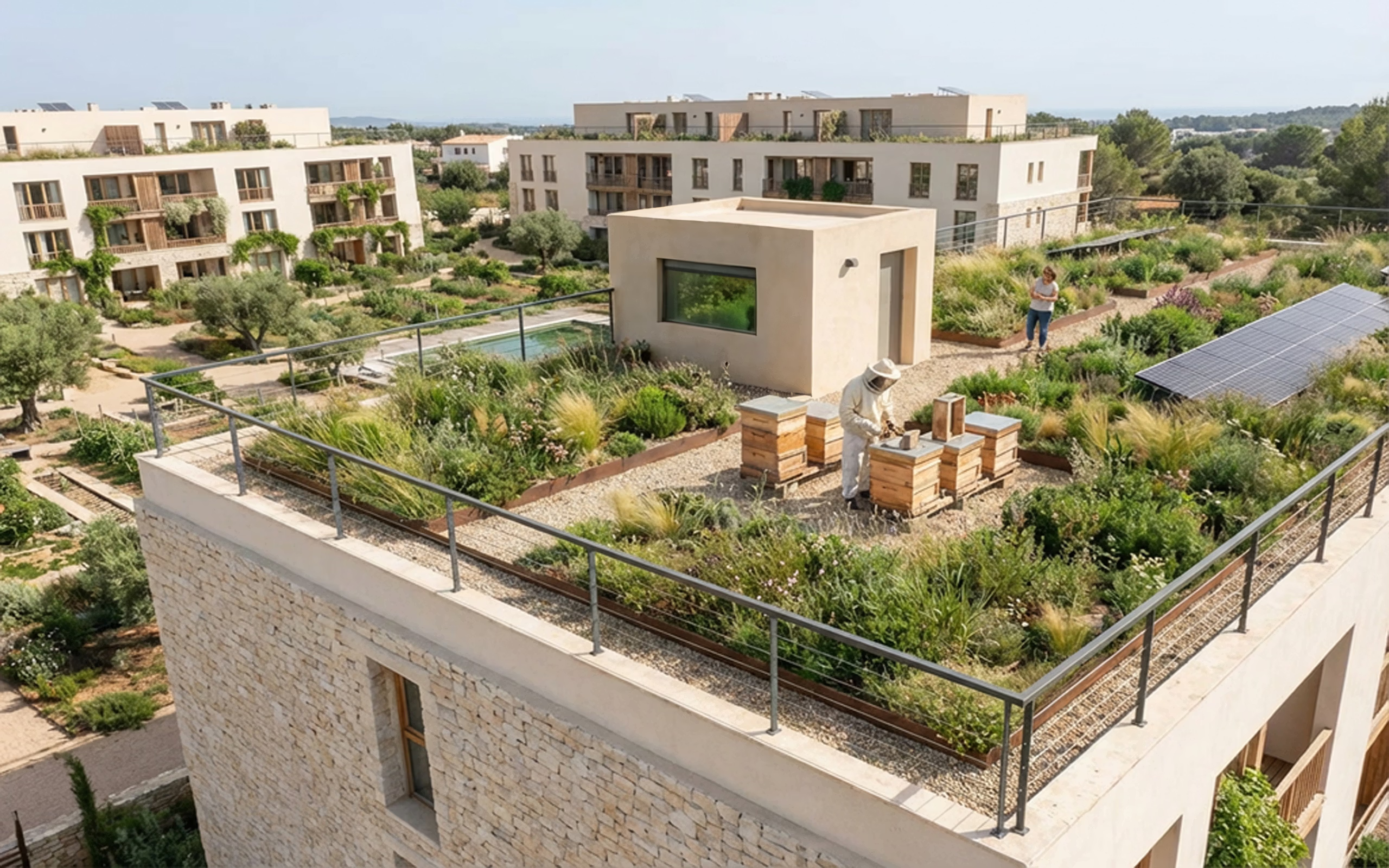
Transforming your dream of learning the art of bee-keeping into reality … and getting paid for it!
Whether it’s a full-time or part-time job, you have plenty of time to spare or not, you’re experienced or a learner, an introvert or extrovert, there’s always some way we can each contribute, with our time, skills, or capital. Together, the community defines what amenities and jobs are needed, qualifications required, and how they’re to be valued in fair and equitable ways.
But the unique purpose of the Community Jobs Marketplace is offering the residents flexible and personal ways we can all participate and contribute meaningfully to the care of our community. The more we dedicate our time and efforts to something, the stronger our bonds grow, the more we care and dedicate to it. A self-fulfilling, ever-improving cycle.
The fourth is stewardship-based ownership.
Having the certainty and security of having a roof over our heads is one of our fundamental human needs. Without that safety it is very hard to reach our potential, and the way most of us achieve it is by owning our homes if we can, and by renting if we can’t. Both options come with their own issues.
Rentals offer an important solution to many people who are not ready to buy. But rentals tend to be viewed as short-term for a reason. When the landlord can increase the rent or kick us out with little notice relative to the upheaval of what moving a home can mean, rentals feel temporary at best and unsafe at worst. Importantly, when we know deep down we will be leaving at some point, rentals don’t generally elicit a sense of care for our neighbors and community.
On the other end of the spectrum, owning our homes in the current market economy (whether to give us safety or increase our wealth), generally leads to extractive, short-term thinking decisions, and over time this concentrates wealth in the hands of those who already have wealth or power.
The process is as follows. Because homes are now so expensive relative to our annual income, we typically buy them with a 30-year mortgage. The interest we pay compounds and gets invested into REITs and other investments or companies tasked with creating short-term returns for investors. The pressure to generate those returns forces companies to become ever more efficient, to build faster and cheaper, most often without considering the costs and consequences of what those actions have on the long-term wellbeing of people or the planet. And because many of those costs and consequences aren’t regulated or taxed, they’re ignored; pushed to the future for other generations to deal with. The investors who make those short-term returns get richer while the residents, communities and the planet eventually pay the real consequences, whether in health, isolation, inequity, agency, climate, biodiversity, and more. While this issue doesn’t just stem from housing, it is a significant contributor.
Both of these realities, whether by renting and owning our homes in our current economy, are caused by a system that focuses on short-term returns and short-term solutions. If we want to improve the wellbeing of people, communities and planet, we need to change the system. And if we want our homes to be agents of good instead of harm, with people who care long-term for the places we live in and the people we live close to, we need to look at the structure of the system, through the way we pay for our homes. If the structure of the system is broken, then what is the alternative? Just as society created this current system, we can also create a new one.
A lot has been written about alternatives, and what we’re proposing is one of them; a system called steward-ownership where we become stewards. Stewards of our land, of our homes, and of our communities. Stewards who care long-term for the whole system.
There are several ways we begin to achieve this, but changing a system is complicated, not least because of the currently competing needs of the different stakeholders of the system:
-
Developers, financial institutions, and investors have the need to generate profit and a certain level of returns.
-
Residents need homes that will keep them healthy and safe and, in this market at least, will protect the value of their assets.
-
Contractors, governments, and communities need to fulfill certain obligations to their clients or constituents.
-
The planet needs us to protect its resources and biodiversity, and so on.
Viewed individually these competing needs all seem to make sense in this market. But viewed systemically and long-term, none of it does. A developer’s need for certain returns directly influences the choice to use cheaper, less healthy or toxic materials, which in turn impacts the long-term health of residents, climate, biodiversity, and more. But future health costs born by residents are not factored into building cost calculations. These impact everyone, including governments who need to increase taxes to build more public hospitals for the sicker population (or reduce coverage, which while unpopular is becoming more common with the influence of big companies in politics).
The cost is in essence passed on to others and into the future, where people’s costs (homes, health and insurance premiums) increase or whose quality of life is reduced, where the planet’s key resources are depleted, where climate and biodiversity are negatively impacted, and so on. Basically, when working in silos, different stakeholders’ needs end up generally at odds with each other (except for perhaps the health insurance companies who may be the unintended beneficiaries of building unhealthy, independent homes).
There is no easy solution other than to come together, embrace the complexity of the system, and to think longer term. To financially link the impact in one part of the system to the other parts. This is the only way to find solutions that protect the people, communities and planet long-term, and to ensure that the stakeholders’ diverse needs can all be met equitably over time. This is undoubtedly the hardest part and we don’t yet have all the answers.
But we believe one option is to start by building homes based on a steward-ownership model. A model which is defined by purpose and where profit is simply one of many tools used to achieve that purpose. Steward-ownership separates the voting power from the economic power so that all decisions made are aligned with the purpose. And in Alluma’s case, whose purpose is to increase the wellbeing of people, communities and planet, all decisions made and actions taken must reflect that.
Where possible, we believe in separating the ownership of the land that the homes are built on, from the ownership of the actual homes. The land is owned by a trust in perpetuity thereby safeguarding its long-term purpose, and the homes are “owned” by purchasing shares in the community. Residents in this model need less capital to purchase a home (as they’re paying a monthly or annual fee for the use of the land, not for the land itself), which means homes become more affordable. And when financing is needed, it’s provided by purpose-driven finance companies whose returns are fair but capped.
This structure makes home ownership more affordable and less susceptible to short-term market pressures, and also means residents can potentially spend more on their own and their community’s wellbeing. A virtuous cycle for all.
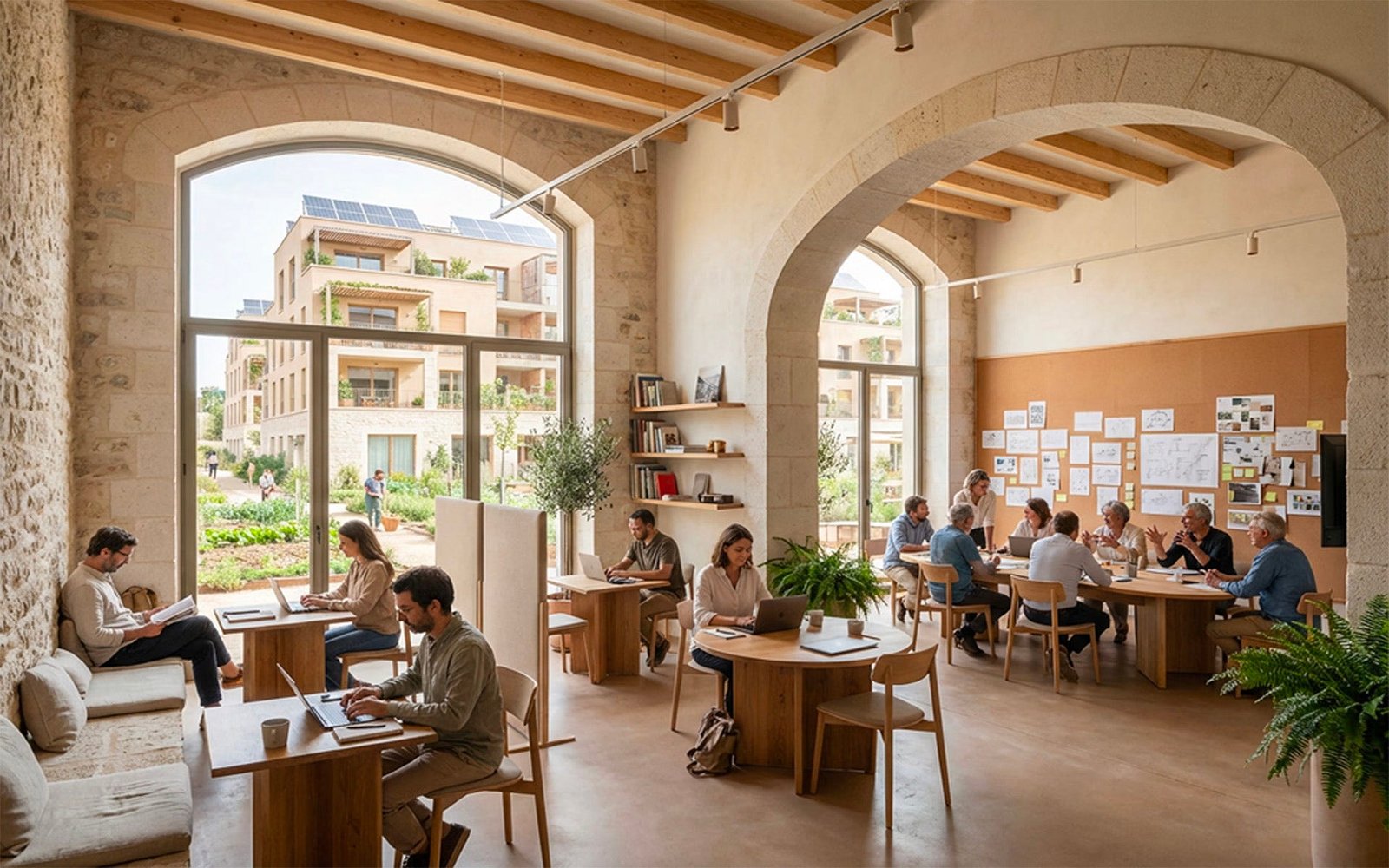
The long-term mindset of steward-ownership naturally generates a sense of care and commitment
The steward-ownership model itself rewards staying, contributing, and caring about each other and our communities, and quietly discourages the extractive behavior that’s turned so much of housing into an asset class and so little of it into a home.
By this point, some of you may have begun asking yourselves a question we haven’t touched on yet. And that is, once we’ve implemented all of these Community and Connection design strategies, how does the community actually function? This is where our fourth foundation: Systems and Technology for Good, comes in. In essence, it’s not enough to provide the strategies and designs that enable community and connection to happen. To function well, a community needs a clear, transparent, fair, and efficient system and governance structure. We can’t wait to share more in the next weeks.
What community looks like on a weeknight
In the meantime, we wanted to share a small glimpse into what we believe our lives at Alluma can look like.
It’s a weekday evening, and a family of four returns home from work and school. Both parents had long days, and the kids are tired from their after-school activities. On a normal night in an isolated house, somebody would now spend 45 minutes cooking while everybody else tried to regroup and recharge. Not tonight at Alluma.
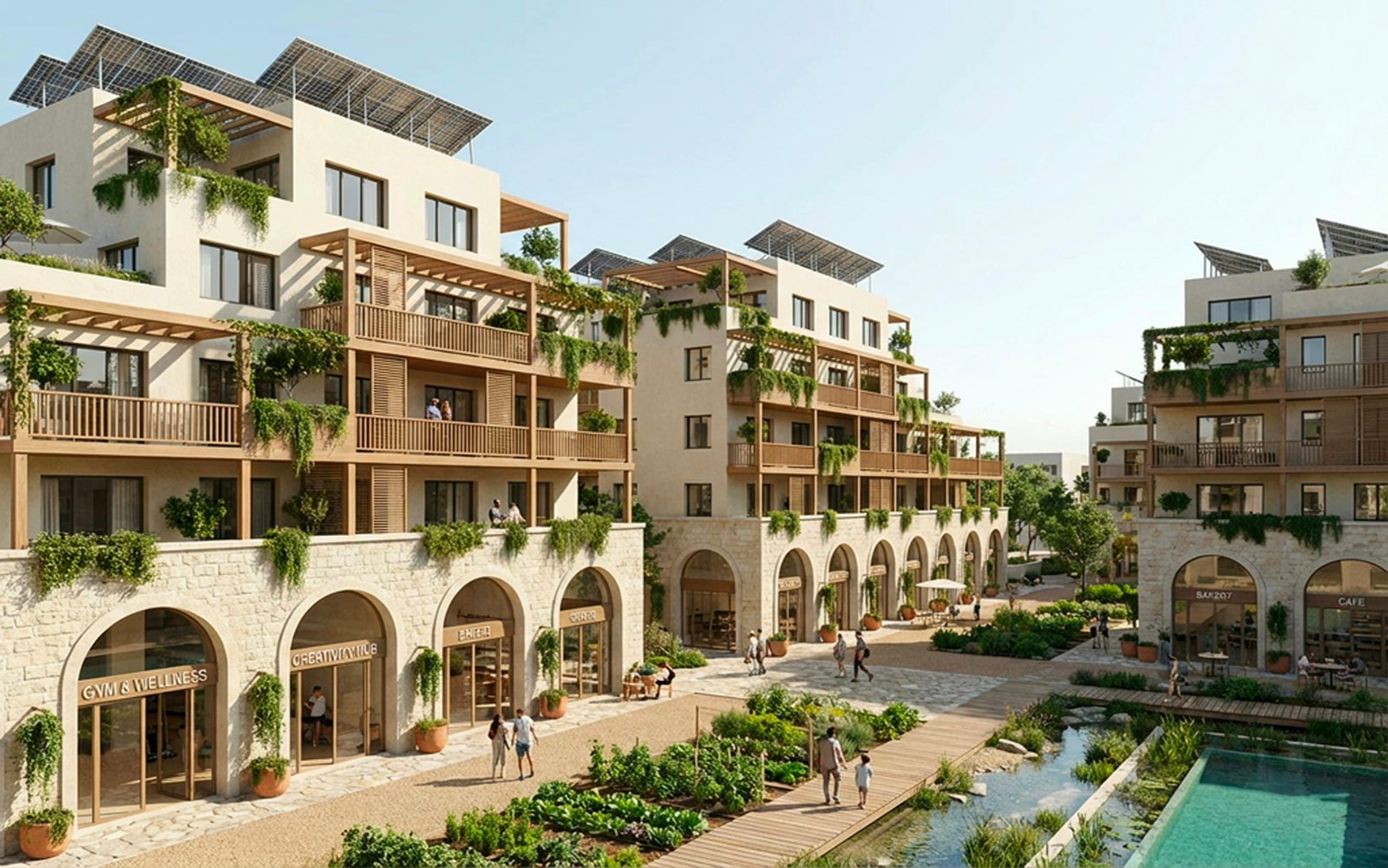
Walking to dinner on a weeknight … past the fruit trees and the water … shoulders drop and we breathe a little slower.
Tonight, they walk along the path to the communal kitchen and dining room. Dinner is already in progress, and the simply prepared but plentiful menu is set. The food is organic and locally sourced. A couple of neighbors who find their joy in the kitchen are part of the professional team that’s in charge of feeding us; they can’t believe they get paid for doing what they love. The kids find their friends. The parents find an adult conversation.
There are mostly long tables that encourage everyone to eat together and make sure no one feels alone. There’s a counter where take-home containers can be packed if that’s what they wish. Phone apps (or wrist bands for the kids) easily register who’s had food and drinks that night.
Nobody is scrubbing a pan. Everyone is engaged with someone, and yet nobody had to schedule these interactions. This is just where people gather or cross paths. Whether it’s for a quick grab-and-run, a transitional space to unwind and relax after a long day, or to have a deep conversation. Every day is different, but there’s space for it all.
Nothing in that picture required an entertainment director, a forced activity, or scheduled community time. Just a set of spaces that gave residents a few reasons to interact, and then trusted them to be a person.
The village I drove through didn’t have a wellness committee. It had quiet streets, buildings close to each other, and doorways that lead out to the sidewalk. It was easy. Everything else just followed.
The next three essays in this series get into the other foundations: Health and Wellbeing; Regenerative Buildings; and Systems and Technology for Good.
Each one matters on its own, but they all exist in service of the same idea: A home is not a box to sleep in. It’s the shape of the life you wake up to. The people you cross paths with. The land you stand on. The ways you get to feel seen and valued by the people nearby.
And that shape can be designed.