
A Home That Fits Your Life. A Community That Expands It.
On trading private spaces for shared abundance and what wellbeing looks like when it's built in from the start.
Wellbeing, when it’s been genuinely designed for, shows up in the smallest moments.
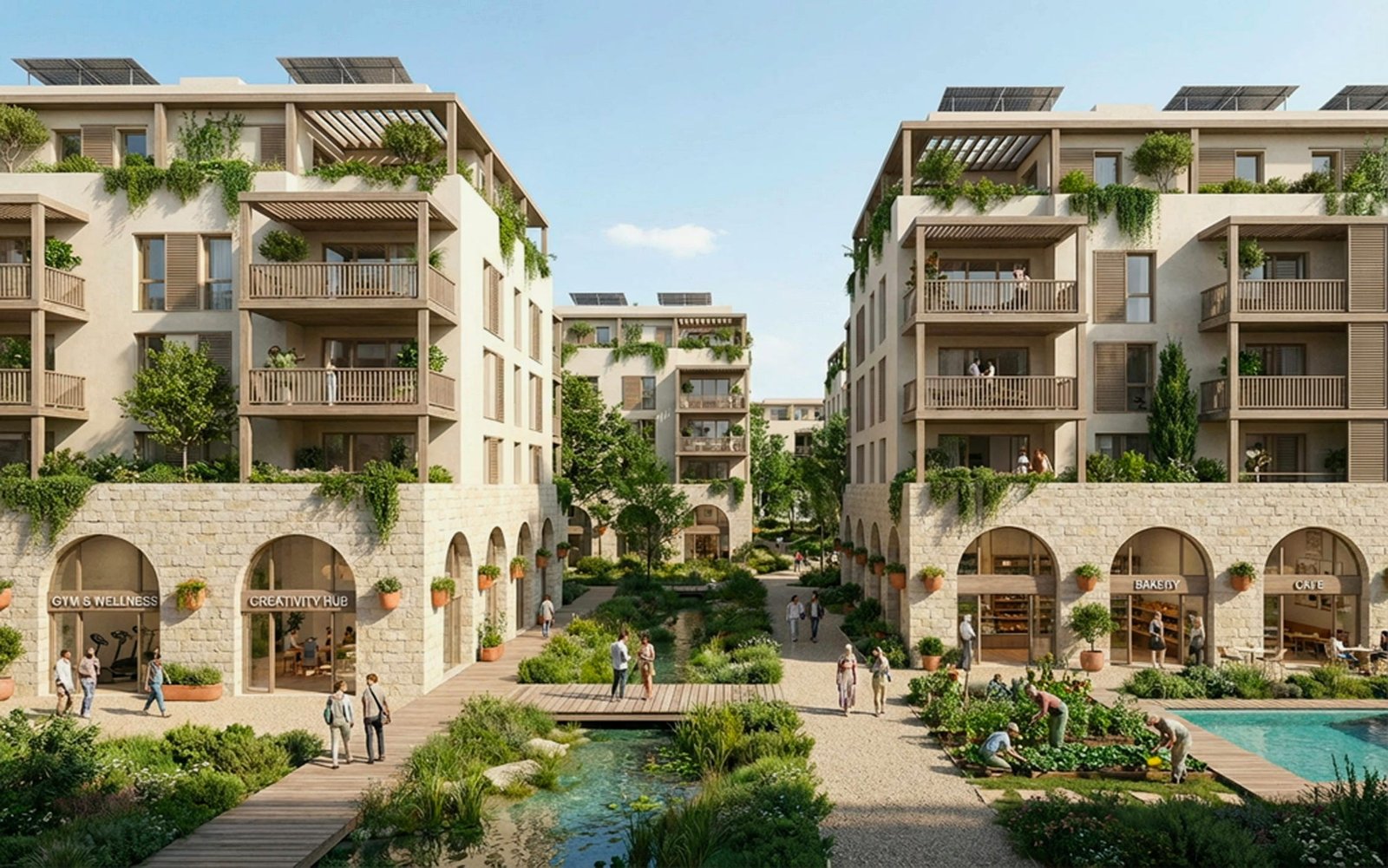
Like a Tuesday morning at Alluma, when you’re walking to the community kitchen for a short coffee break. Walking through the gardens, you see someone stretching in the yoga studio and make a mental note to join a class in the evening. Two other neighbors are chatting about their day’s plans while tending to the vegetable beds. Their unhurried hands deep in the soil. You notice your shoulders relax and your heartbeat slow a little. When you reach the bakery and café, where coffees, teas, granola bowls and smoothies are being made, you start chatting with some of the other neighbors who had the same exact idea as you.
There’s a particular feeling in that kind of morning that’s hard to name precisely. It’s something like ease with the sense that the day ahead is full of things worth doing. You went for a 20 minute coffee break, but came back with fresh air in your lungs, filled with energy, a clear mind and most importantly, a positive outlook because you know you’re not alone.
That morning, as ordinary as it sounds, is what health and wellbeing means. It’s not the absence of illness or a list of amenities but something much closer to that feeling. And it’s something we believe can be deliberately, carefully designed for.
This is the third piece in a four-part series on the foundations of Alluma, the regenerative communities we’re building. The first essay was about designing for community and connection. The second was about the systems that hold a community together. This one is about what we actually mean by health and wellbeing and how we’re designing for it at Alluma.
Health and wellbeing is bigger than we usually think
When most of us hear “health and wellbeing,” we tend to picture something fairly specific, like a gym, green juice, or a good night’s sleep. Those things matter of course, but the more we’ve worked through what Alluma needs to be, the more we’ve come to believe that health and wellbeing is actually the thread that runs through everything, and that most of the things that genuinely affect how we feel day to day have much less to do with what we usually call wellness.
Take loneliness, for instance. The isolation that comes from living behind closed doors is one of the defining health challenges of our society. But it’s something we created, and something we can change, and it’s rarely framed that way. We explored that in depth in our first essay on Community and Connection.
Or take agency, the sense that our voice matters in how we live, that our concerns are heard, and that we have a real say in the decisions that affect us. Lose that, and something quietly erodes. We explored that in the second essay on Systems and Technology.
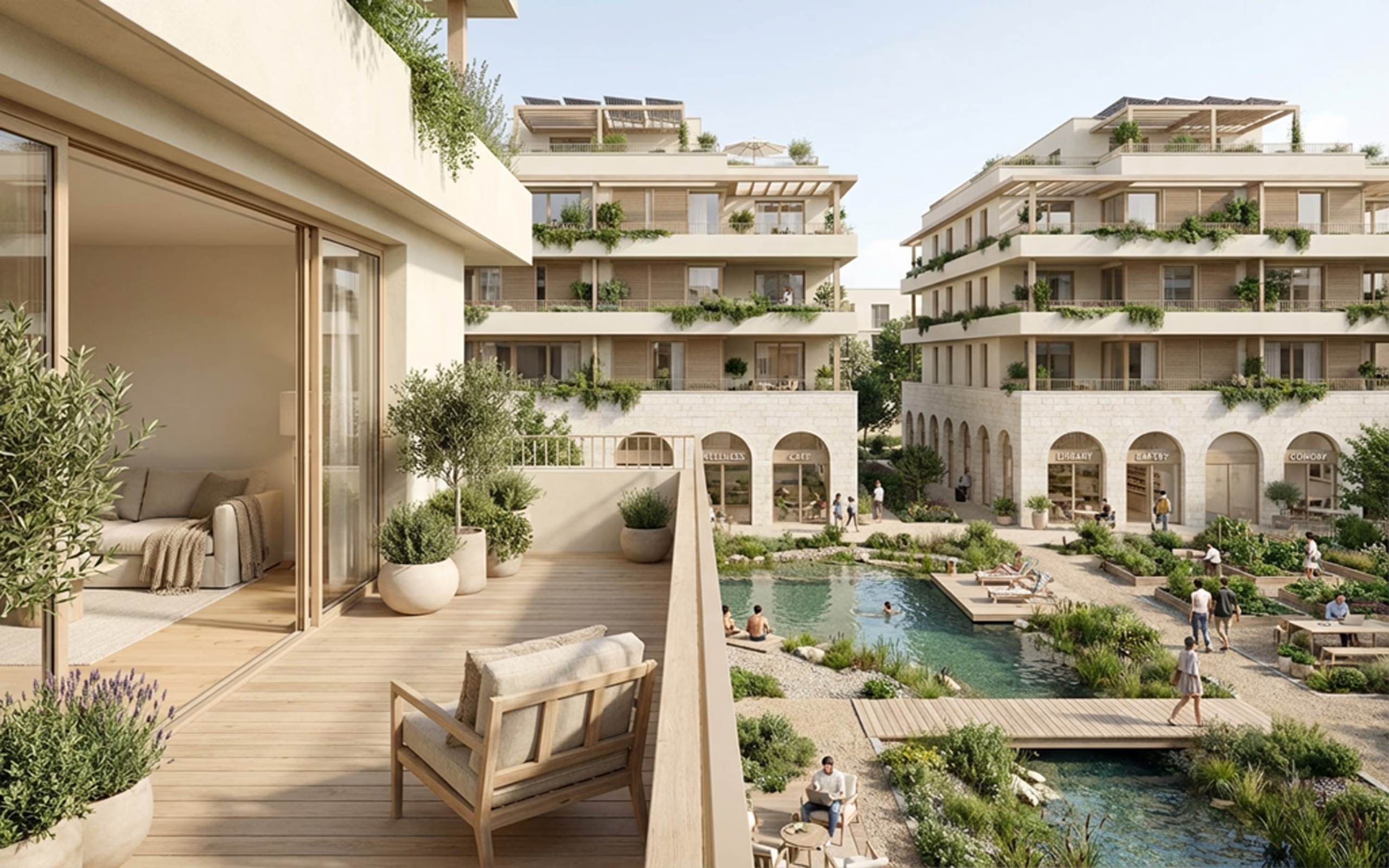
And then there’s the building itself (the materials, the air, the light and more), which shape our bodies and minds in ways most of us don’t even realize and have never been told about. We’ll go into that in the next essay because it deserves its own space.
This essay focuses on what sits at the center of all of that: the balance between private and communal life and what it actually looks like to design a home and a community that supports the whole person.
The case for right-sized homes
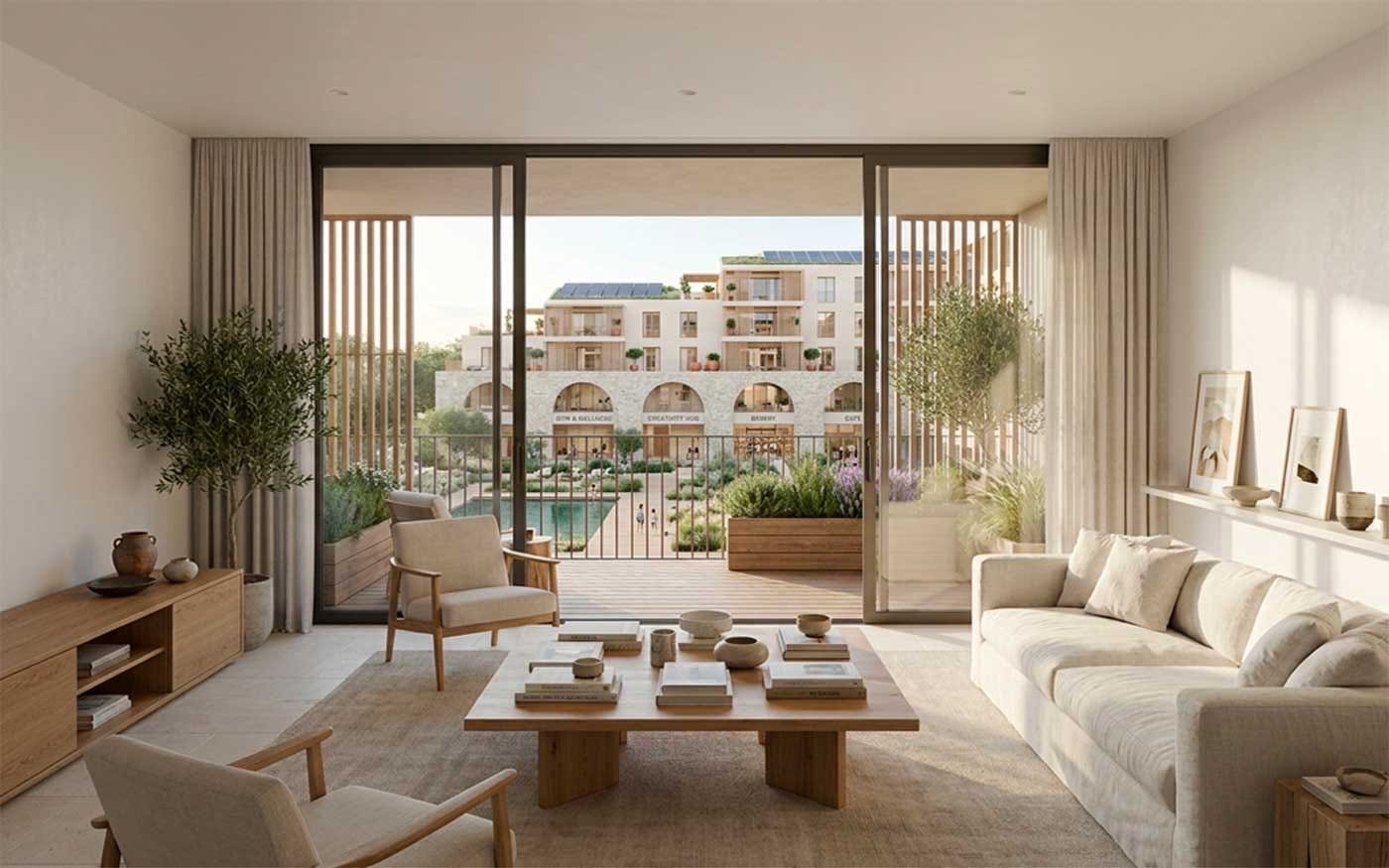
Most of us have grown up with a particular idea of what a “good” home looks like. That bigger is better, and more rooms means more options, more convenience, more independence. The dream, for most of us, has always been more space, more privacy, and more of everything, so that, as our incomes grow, so do our homes. The more successful we become, the more we include inside our homes, needing less and less from the outside world. But eventually, when our dream comes true and we have the grand bedrooms and bathrooms, the private chef’s kitchen, a laundry room big enough for a small army, the guest rooms for occasional visitors, our own gyms, theaters, gardens and pools, then what?
I’ve been questioning that assumption for a long time. Not because privacy doesn’t matter (it does, deeply), but because once we have access to a certain level of privacy, the pursuit of more private space tends to come at a cost we rarely account for.
More space not only means more of our time, money and materials going into rooms we might use twice a year, it also means more to clean, maintain, heat and cool. Sadly, it can also lead to more isolation because the bigger and more self-sufficient our private homes become, the less reason we have to step outside them.
At Alluma, we’re designing around a different idea. We call it the right-sized home, or, as I sometimes think of it, the Goldilocks home. Not too big, not too small, but just right for our needs. Big enough for everything we genuinely need private space for, without the extra space that can make a home isolating, expensive and exhausting to maintain.
So what are the spaces we should keep private, and which could bring us more benefits from being communal? What is society telling us should be standard, versus what we really need as human beings? Some spaces are easily defined as private. They’re the ones that either get used daily and often, like our bedrooms and bathrooms, or because their functionality is inherently private, like a living room that allows us space for downtime, relaxation, closer connection, or quiet, that would be harder to achieve in a communal space. Those are the our private spaces and should stay in the home.
On the opposite end of the spectrum are spaces which given their size, cost or infrequent use, or because we benefit from their being communal, make good sense to share. These are the pool, library, gym, and theater. And somewhere in the middle, are the other spaces that tend to be more subjective. In these cases, we can provide optionality. For example, compact kitchens inside our homes to prepare and have access to food and drinks when we’re home, with professional kitchens and dining spaces outside the home that feed the community the rest of the time. Or flexible home layouts that can easily adapt from dining and living spaces into home office spaces as needed throughout the day.
But letting go of the picture of what is standard or what is included an ideal home takes a genuine shift in how we define what a home is. That is, until we understand that adding all those spaces inside our homes is what caused us to lose a vital part of our human essence: our need for connection to others and to nature.
By reimagining our homes and redesigning what spaces to keep private and which communal, what we get in return is so much more. Our private homes become the private, intimate space we need to connect to ourselves, both individually and as families, on a deeper level. A place for calm, depth, rest, and peace. A sanctuary of sorts.
And because we’re using less square footage and budget on rooms we rarely use, we can invest more in communal amenities, better materials, light, ventilation, sound, temperature, and elements that impact our health more directly.
We trade private spaces for shared abundance, and we believe it’s a trade worth making.
What shared amenities actually make possible
So what does that shared abundance actually look like?
Here are a few examples of amenities that a community of about 100 homes could share:
- Physical wellbeing (a natural pool, a gym, fitness rooms, sport courts, yoga and pilates studios) because strength, movement, and physical vitality matter at every age, and they’re far more likely to become part of daily life when they’re steps from our front door rather than a car ride away.
. - Wellness (a sauna and cold plunge, a meditation room, spaces for massage, and personal care) because recovery and the small rituals of looking after ourselves aren’t indulgences. They’re part of what keeps us functioning well, feeling confident, and showing up for others.
. - Nature (gardens, paths, water, vegetable, and flower beds, bee hives and a chicken coop) because there’s something that happens to us when we spend too much time away from living things that no amount of good interior design compensates for. Connection to the natural world grounds us in a way that’s hard to articulate but immediately felt.
- Good food (a communal kitchen, shared meals, healthy ingredients grown close to home) because what we eat is one of the largest influences on how we feel long-term, and most homes are designed in a way that makes the most convenient food also the least nourishing. We want to change that default.
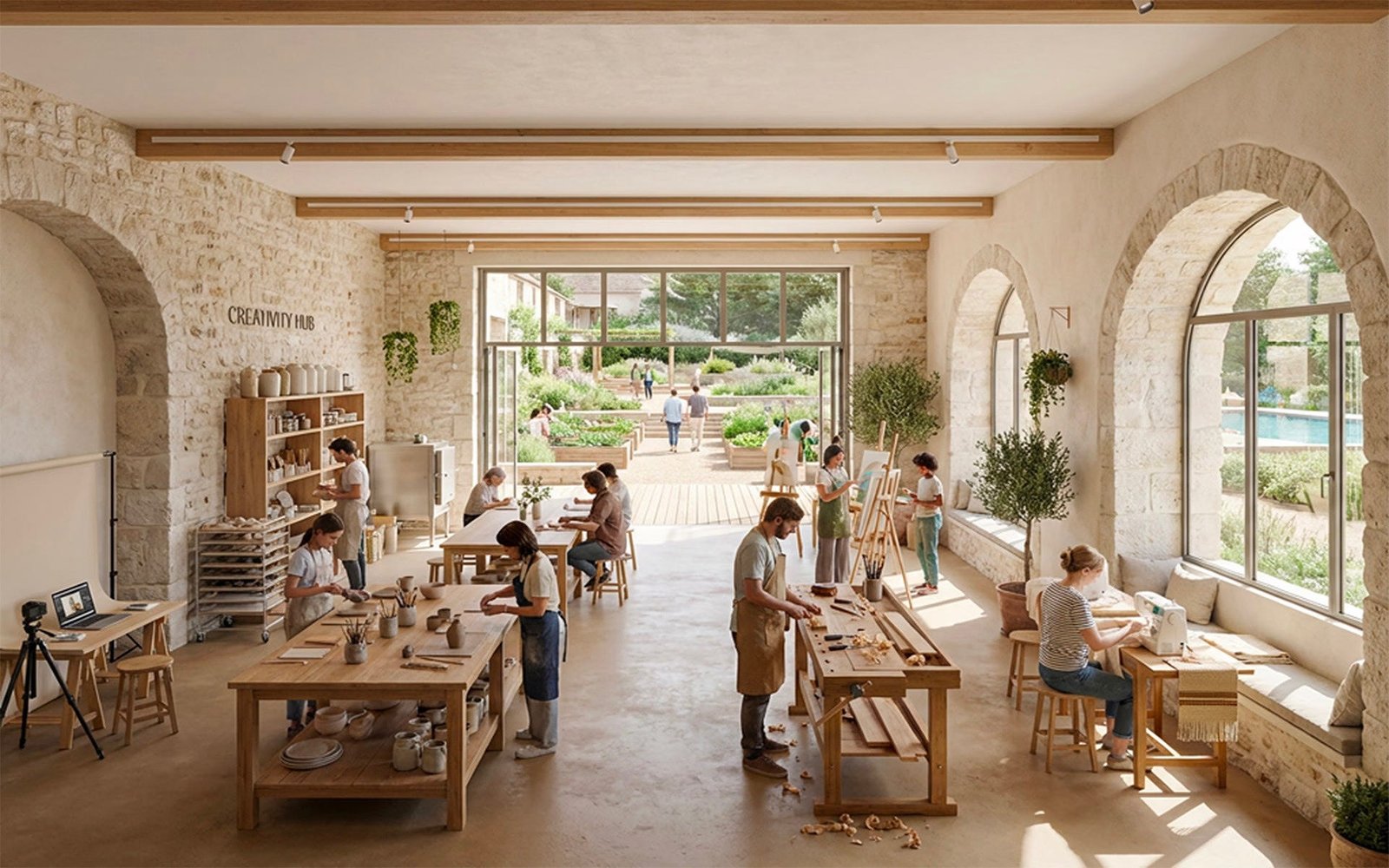
. - Creative spaces (painting, drawing, ceramics, textiles, carpentry, photography, music room, recording studio, maker spaces) that teach us to express and learn about ourselves in unique ways. These opportunities teach us new skills and focus, and help reduce stress and anxiety.
. - Learning and work spaces (library, co-working space, learning center, commercial spaces) because curiosity and the exchange of knowledge -learning and teaching in equal measure- is something we believe should never stop, at any stage of life. And live-work spaces provide opportunities to earn a living full of meaning and purpose, as well as to connect to the wider community too.
. - Indoor and outdoor play and entertainment spaces for all ages (hang-out spaces, games rooms, climbing wall, jungle gym, movie theatre, gallery) because joy and playfulness are health too, even if we rarely talk about them that way.
We’re not saying that we will always have all of these amenities in each community, as space and budget do limit our options. But if, as a community, we prioritize the most important elements from each category and embed adaptability into the designs, it can be surprising to see what’s possible. When we prioritize taking care of our bodies, our minds, and our hearts, we show up at our best for ourselves and for each other.
On wanting community and independence at the same time
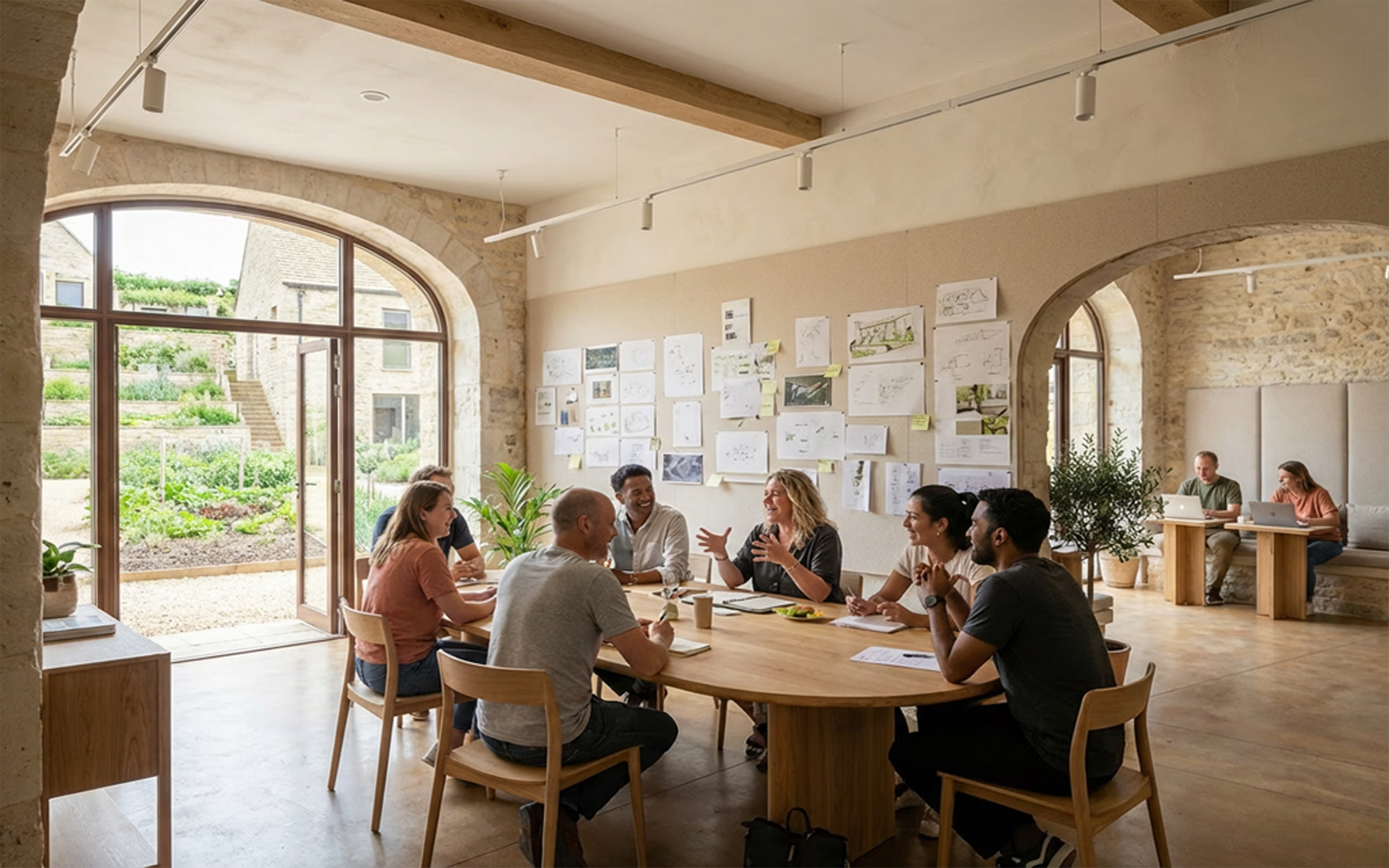
Choosing shared abundance over private space is one thing. Living it, day to day, with a hundred different people who have a hundred different needs is another.
Most of us want community, and most of us also want independence. We want neighbors who notice when we haven’t come down for coffee. We also want to be left alone when we need to be. The tension between those two things is real, and there isn’t a simple answer.
The reason most of us end up retreating into isolated, self-sufficient homes isn’t because we don’t value connection. It’s because navigating difference is genuinely hard, and most of us don’t have the tools, the time, or the energy for it.
How do we handle the neighbor who wants to celebrate until midnight with music when someone else has an early morning? How do we share a pool between the person who wants to swim laps and the family whose kids want to play?
Faced with those questions, most of us take the path of least resistance: we opt out, hide behind our own doors, and trade the friction of shared life for the quiet of our private homes.
What Alluma is trying to do is give communities the tools and structures to navigate those moments so that difference doesn’t have to mean conflict and division, and shared life doesn’t have to mean losing ourselves.
A well-designed party room with good soundproofing means the celebration doesn’t have to end at 9pm, and the neighbor with the early morning can still sleep. Agreed-upon times for lap and open pool swimming offers options for everyone; and sensible guidelines that encourage communication and offer flexibility, means that if nobody is actually using the lane, anyone can jump in.
Rules aren’t fixed forever. They can and should be easily adaptable as the community’s needs evolve. These aren’t perfect solutions (living with others never is), but they’re the difference between community as something that happens to you and community as something we actively shape together.
When the framework for decision making and resolving conflict is sturdy and fair, something shifts. Issues that might otherwise feel personal become practical. Instead of conflicts becoming about personalities, they become about finding workable solutions that everyone can live with. That shift is what makes the difference between a community that slowly fractures and one that genuinely grows stronger.
What balanced private and communal spaces feels like
The goal isn’t the biggest home or a perfect community. It’s a Tuesday morning that feels, without anyone having to try very hard, like a good one. With access to healthy private homes, extraordinary communal amenities that enhance our wellbeing, and adaptable to our changing needs. That’s what we mean by Health and Wellbeing at Alluma, and it’s what we’re designing toward.
The next essay goes into how we build the buildings themselves and what it actually means to give back more to the planet than we take. Because a healthy community without healthy buildings is still only half an answer.
Subscribe to get the final foundation essay sent right to your inbox.