
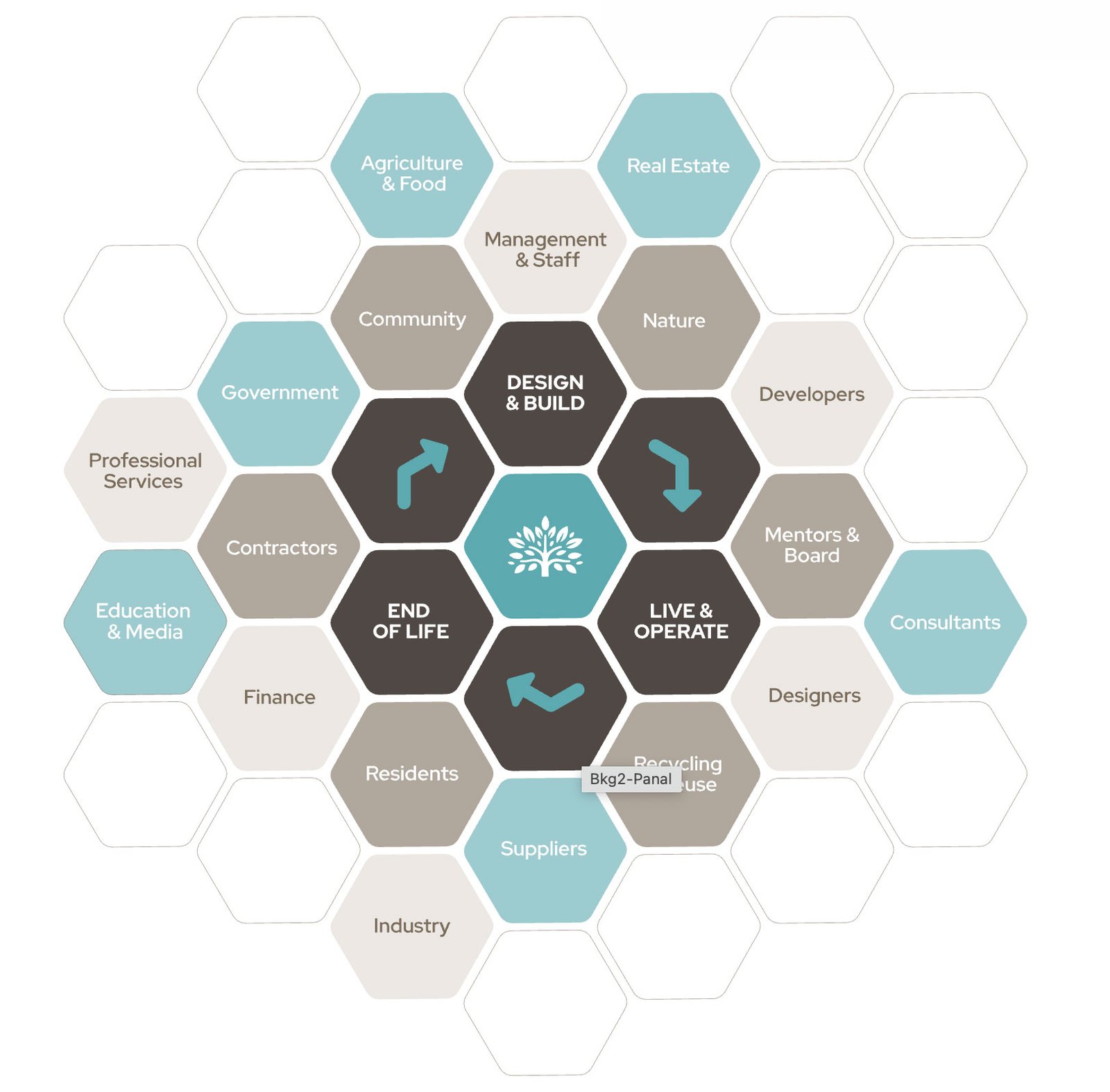
Building a better ecosystem
How we're structuring Alluma with patient capital, a purpose-locked legal entity, and an alliance of partners. All before a single wall goes up.
This summer, building a regenerative community has looked less like blueprints and more like inboxes, zoom calls, and meeting new people and organizations. Less like digging foundations and more like finding the right legal framework. It looks like early morning calls with an investment fund in Austria that focuses on projects that improve wellbeing. It looks like deep conversations at conferences, research with impact consultants, and discussions with potential lawyers in Spain to translate concepts like sociocracy and steward ownership into something that Spanish law will actually recognize.
This is not the part of the process that creates beautiful renderings and inspiring moodboards, but it matters just as much as anything that will eventually get built.
Because we're not only building a first-of-its-kind regenerative community, we’re also trying to create a new ecosystem. A business framework and a network of partners and stakeholders, structured and connected to withstand the short-term pressures of today's economic systems. The objective is to build homes that improve the health and wellbeing of all.
This takes longer and is definitely harder than a typical development. So many conversations have revolved around a version of this sentence: “Why don’t you simplify and make it easier on yourselves by leaving out X from your project?” The X changes in every conversation depending on the other side’s perspective. I’ve heard:
- Forget the Living Building Challenge. It’s too costly, time consuming, or too hard to do it all.
- Forget steward-ownership. No one has heard of it. It’s too complicated.
- Forget capping returns. People will never choose to willingly give up potential wealth.
- Forget trying to coordinate all the other stakeholders. You'll never find agreement.
- Forget sharing amenities. People will never agree to share.
- Forget sociocracy. Nobody has the time or interest to dedicate to their community.
... and the list goes on.
But if we “forget” any of these things, some part of the system breaks down, and we fail to achieve the real results we’re all looking for: regeneration. To improve what’s been harmed, depleted, or destroyed, and to improve the long-term health and wellbeing of all. Human beings, biodiversity, society, and the planet as a whole.
A lofty goal, no doubt, but if we’re not brave enough to try, what’s the point? Alluma’s objective isn’t just to build more homes, it’s to find a better way to build them.
This summer, some of that has actually started to take shape. Three pieces are all moving at once: defining what kind of capital funds the project, what kind of legal structure frames it, and who builds it alongside us.
This is part of what we’re calling “the ecosystem” of building better homes, and it starts long before anyone breaks ground.
Here’s what we’ve been up to.
Money on a longer clock
Most development money comes with a ticking clock, like a return expected by a fixed date, which shapes every decision that follows. Cut a corner here, rush a material there, choose whatever ships on schedule over how it might impact health and wellbeing, or whether it will last long enough.
We're not looking for that kind of capital. We're building toward impact and patient capital instead, meaning we’re interested in capital that is willing to trade speed and certainty for something that creates real (not just financial) value and is durable and resilient enough to be worth the wait. We're interested in capital that demands more than financial returns. Capital that is more equitable in how value is distributed among those who contribute to creating it, and capital that also looks for resilience long-term. This kind of capital is not charity or philanthropy because it still demands that a project or business be profitable and sustainable over time. This capital is a little more patient so that better, longer-term decisions can be made, and the upside is capped to ensure it can be distributed more equitably.
Today, if a building takes longer than the industry standard, it’s considered financially unacceptable, and yet, some of the most beautiful, timeless buildings in the world took decades to build. Why? In part because of different technologies, but in part because those at the helm weren’t trying to build something purely functional or for a financial return. They were looking to build something enduring, something beautiful, and were willing to take the time to design with detail and care, to build with the right materials and processes, and to build with a purpose that looked beyond immediate financial returns. We’re not saying we should expect Alluma communities to take decades to build, but we are taking our time to ensure we build better. Not just the buildings, but the whole ecosystem itself.
This past spring, I started working with a fund called West Asia Investment Partners to help update and build on the business plan I’d already written. A lot has changed since I last built a company that needed fundraising, and I wanted help creating a more detailed financial and business model, as well as the strategic plan for turning Alluma into reality.
I wanted to make sure Alluma’s concept is viable (economically, financially, and legally) and enduring, so that when it’s time to reach out to team members, banks, investors, home buyers, and stakeholders, we’re not just presenting a well-intentioned vision, but something that will actually work for, and benefit, all.
It’s been quite the process, and an incredible collaboration, with significant progress made. The WAIP team is made up of experienced, wise, kind, open-minded, long-sighted people. Exactly the kind of partners Alluma needs. Soon we’ll have our first real draft and will start reaching out to those who recognize our vision and mission. That’s when the real pressure testing will begin. This stage is incredibly exciting, especially with all the positive feedback so far, but also a little terrifying. Two years in, and with a lot of my own time and money invested, it’s time to see where Alluma really stands.
And while this is still just the beginning, what’s telling is that the feedback we hear most is a mix of surprise, and sometimes even a little relief, at how much thought is going into Alluma. Not just what and where we hope to build, but how, with whom, and with decisions made with longer timescales. Not just to be careful but to understand the long-term impact of how we structure Alluma. Because if we hope to design better homes, we must also create an ecosystem capable of achieving Alluma’s purpose of improving the health and wellbeing of all.
Structuring Alluma and the ecosystem to protect the mission
A mission is easy to protect when we’re the only ones in the room making decisions. The real test comes the moment anyone else has voting power, including investors, board members, potential partners, banks, and so on.
So before we even begin, we’re building a legal and organizational structure that can protect our mission. In practice, this means several things.
It starts by including our purpose in the business charter. Most companies today use standard charters which state that the purpose of the company is to maximize profits for their shareholders. Alluma’s purpose is to improve the health and wellbeing of all, which means that all decisions made must serve that ultimate goal. This is called mission-lock, and while it seems like a simple enough change, it changes everything. It means every decision, from the biggest (like deciding to expand into a new industry) to the smallest (like choosing which napkins to buy), must be answerable to that purpose.
Next, it means separating who has voting rights (and controls the mission), from who has economic rights (and profits from the business), so no one can vote, even in times of emergency, to ignore the mission for the promise of a bigger paycheck. This is steward ownership, where stewards own the voting shares that ensure the direction of the company stays aligned with the mission.
Luckily, while these concepts are not broadly known, they’re not new and we can follow in the path of other pioneers like Patagonia, Bosch, Novo Nordisk, Signal, Ecosia, John Lewis Partnership, Mondragón, and Eileen Fisher, among many others. All very different companies that exist in different industries and countries, but all structured to protect their purpose; refusing to let short-term profit outrank the reason the company exists in the first place.
As I deepened my understanding about steward ownership, I learned that Spain doesn’t have a ready-made legal entity for a mission-locked, steward-owned company. But after meeting with many different law firms and consultants, found that we can indeed create work-arounds.
While many firms were not well versed in this subject, we’re very lucky to have found a few pioneers leading the way. These include Somos Stewards, the Spanish arm of the Purpose Foundation, and Gabeiras, a law firm whose entire practice is built on using the law as a tool for transformation to create a more just and equitable society.
The alliance of partners, in practice
Most multi-home residential projects get built in silos and serve the vision and needs of whoever’s financing it, instead of the people who’ll actually be impacted by the finished buildings.
We’re building Alluma differently, as an alliance of partners: architects, designers, builders, financiers, local government, biodiversity experts, and community representatives, future residents, and more, all at the table from the beginning, sharing their needs, perspectives, and in many cases, the risks and benefits together.
Instead of developing a project only to realize it didn’t meet the right needs, or worse, without caring about the impact it might cause others over time, our alliance of partners ensures that everyone has a voice in what gets built.
This summer we’ve started building our alliance and this is what it looks like so far.
We’ve signed on Jason F. McLennan as lead architect. Jason is the creator of the Living Building Challenge (the standard our whole approach to building regeneratively is based on.) He is also founder of McLennan Design and chief sustainability officer of architectural giant Perkins & Will, whose tag line is about creating “places where humanity thrives in harmony with nature.” Jason has spent his entire career solving exactly the kind of challenges we’re going to run into, and he’s choosing to help us solve them.
We have a partnership with West Asia Investment Parters, led by Bijan Khajehpour and a wonderful team that has been helping to develop our business plan. In addition, Bijan has agreed to come on board to become my co-founder as we work to propel Alluma into our next phase. I am immensely grateful to have him walk on this path by my side.
Somos Stewards, guided by Sandra Castañeda, has been a most invaluable resource in helping us figure out how to structure the various entities and operations in Spain to ensure we are mission-locked. I’m very much looking forward to continuing our collaboration with the Somos team and especially with Sandra, a wonderful human being who has spent 25 years dedicated to regenerative economies and helping organizations connect to and protect their purpose.
Different people, different expertise, same goals. All pulling in the same direction instead working in silos executing a separate piece of someone else’s plan.
We’re in the early stages where it’s mostly conversations and commitments so far. But that’s the point. The alliance isn’t something we’re announcing once it’s complete. It’s something we’re building carefully, one real partner at a time.
Where we go next
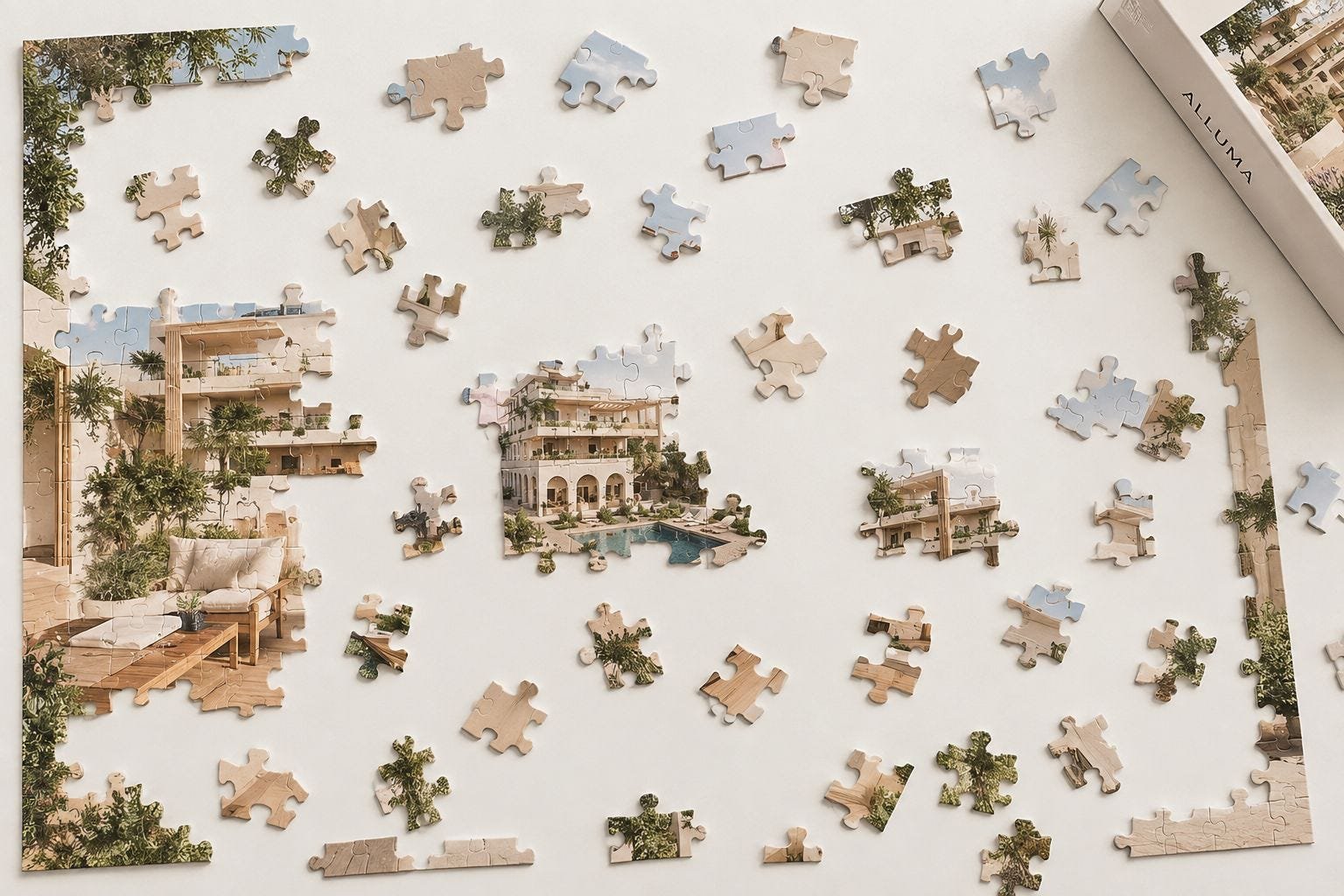
As we try to juggle all the pieces of a very complex puzzle, I’m reminded of Mark Watney, played by Matt Damon in The Martian, when he says “You just begin. You do the math. You solve one problem... and then you solve the next one... and then the next. And if you solve enough problems, you get to come home.”
This summer, we started building the border of the very real and complex Alluma puzzle. As we progress, we’ll gather more of the pieces that fit around and inside it, one at a time, until the image is clear.
As we transition from summer to fall, it feels like turning a corner, slowly getting to see sections of the puzzle that make sense. And we’ll keep working away at all of the pieces, step by step: the money, the structure, the partners, and the people. Different pieces, each moving at its own pace, each one still measured against the same question: does this protect the Alluma mission?
One piece, one decision at a time. Not because it’s easy, but because if we want to build something better, it’s the only way we can.
Interested in joining the alliance? If you read this and thought, “I have a puzzle piece to contribute,” we’d love to hear from you.